The angle of repose is the steepest angle at which a pile of granular material remains stable without sliding. This has important implications if your house is near a hill. However, hillslope creep has been observed well below this critical angle.
One reason is these guys.
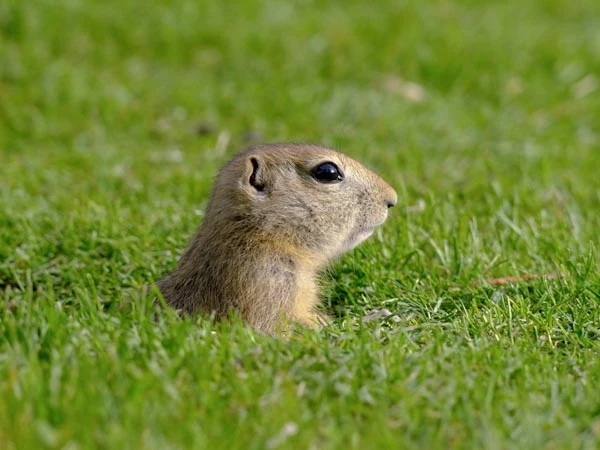
Burrowing animals displace and deform the soil, which causes micro-failures.
Here we model hillslope creep with mostly passive grains and a few active ones, all interacting through Coulomb friction. The active grains swell and shrink, representing bioturbation (or freeze-thaw cycles).
This is a very simple form of active matter. A grain does work on its neighbors by changing its size rather than by moving itself. The activity is set by two parameters, the fraction of grains that are active and the swelling amplitude a, how much a grain's area grows relative to its own size. Speed does not matter, because the model is quasi-static.
Below is the simulation, with bidisperse grains and Coulomb friction μ = tan 30°.
It may be slow because it's a JavaScript version of qsdem.github.io. With no swelling nothing moves.